Chap1 Introduction
Basic concept of the FEM
FEM
Finite Element Method: A numerical technique for obtaining approximate solutions to differential equations
-
FEM discretizes a physical domain into many elements
-
Then reconnect elements at nodes as if nodes were pins or drops of glue that hold elements together
-
This process results in a set of simultaneous algebraic equations( 一组联立的代数方程组 )
example
Engineering problems( 工程问题 ): structural analysis( 结构分析 )、thermal analysis( 热分析 )、fluid flow( 流体流动 )、electromagnetics( 电磁学 )、buckling( 变形 )
Physical model( 物理模型 ): governing equation( 控制方程 )\(L(\phi)+f=0\)、boundary conditions( 边界条件 )\(B(\phi)+g=0\)
FEM: a set of simultaneous algebraic equations
concepts summary
- A set of simultaneous algebraic equations at nodes
-
K-property U-Behavior F-action
-
FEM uses the concept of piecewise polynomial( 分段多项式 ) interpolation( 插值 )
-
By connecting elements together, the field quantity becomes interpolated over the entire structure in piecewise fashion
General steps of the FEM
Step 1: Discretize( 离散化 ) and select the element type( 选择单元类型 )
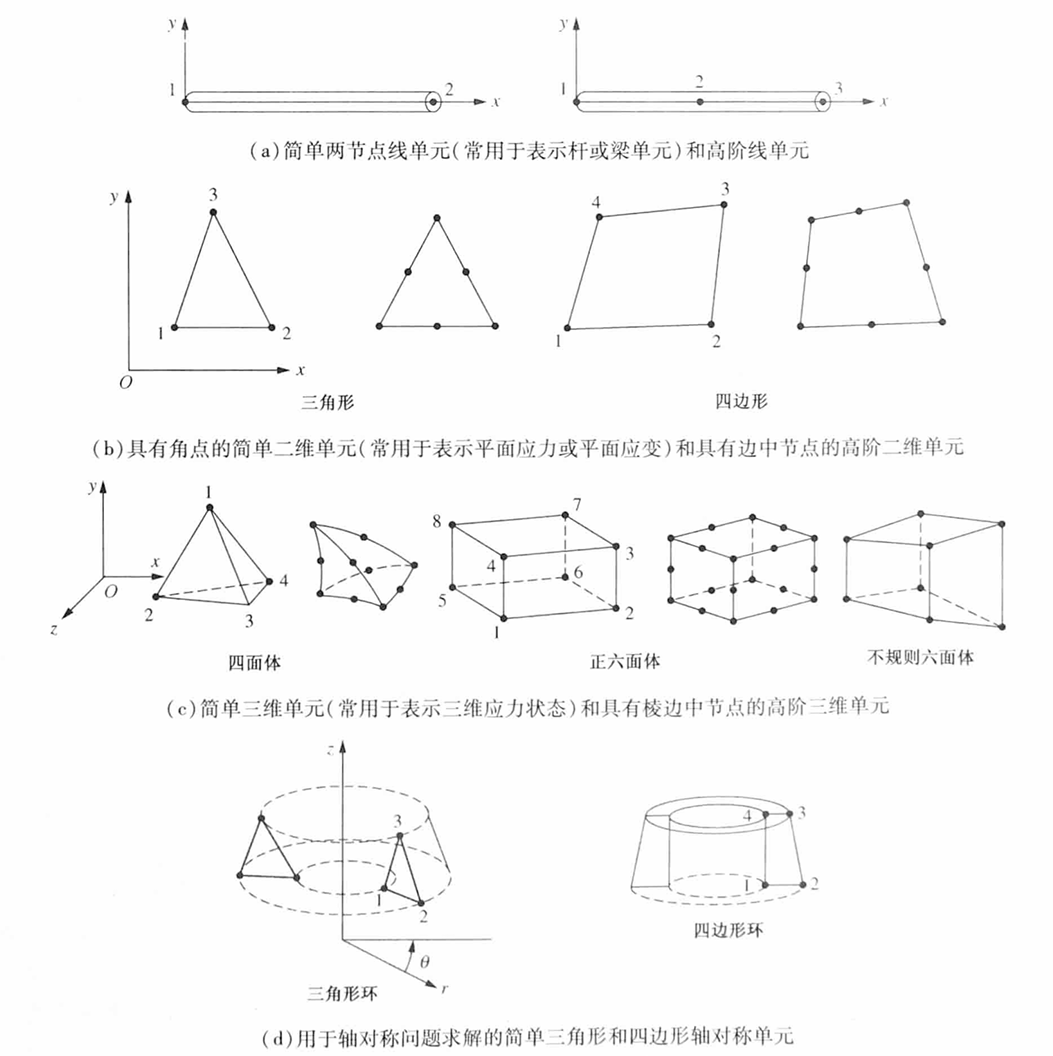
Step 2: Select a displacement function( 位移函数 )
Step 3: Define the strain( 应变 )/displacement and stress( 应力 )/strain relationships
对于一维线弹性情况,小应变的应变 \(\varepsilon_x\) 和位移 \(u\) 的关系为
应力和应变通过本构关系关联,胡克定律为最简单的应力 / 应变定律
Step 4: Derive( 推导 ) the element stiffness matrix( 单元刚度矩阵 ) and equations
Step 5: Assemble( 组合 ) the element equations( 单元方程 ) to obtain the global equations( 总体方程 ) and introduce boundary conditions
组合方程或总体方程的矩阵形式如下
其中 \(\{F\}\) 为总体节点力矢量,\([K]\) 为结构总体刚度矩阵,\(\{d\}\) 是结构已知和结构未知的节点的自由度或广义位移
Step 6: Solve for the unknown degrees of freedom( 未知自由度 )
写为扩展的矩阵形式
其中 n 是结构未知节点自由度的总数
方程可用消元法或迭代法求解,得出所有 d 值;d 值是利用刚度(或位移)有限元方法获得的第一组量,因此称为初始未知量
Step 7: Solve for the element strains and stresses
Step 8: Interpret the results
Applications of the FEM
Application in Engineering
- Structural problems
- Stress analysis(static/dynamic, linear/nonlinear)
- Buckling( 屈曲 )
- Vibration( 振动 ) analysis
- Nonstructural problems
- Heat transfer analysis(steady/transient( 瞬时 ))
- Fluid flow
- Distribution of electric or magnetic petential( 电势或磁势的分布 ))
Errors of the FEM
FEM only obtains approximate solutions with inherent errors( 固有误差 )
评论区